 HOME
 CONSORTIUM
 CONTACT
 IMPRESSUM
 RESTRICTED ZONE
for MULtimaterial
3D printing of
microneedle
electrodes
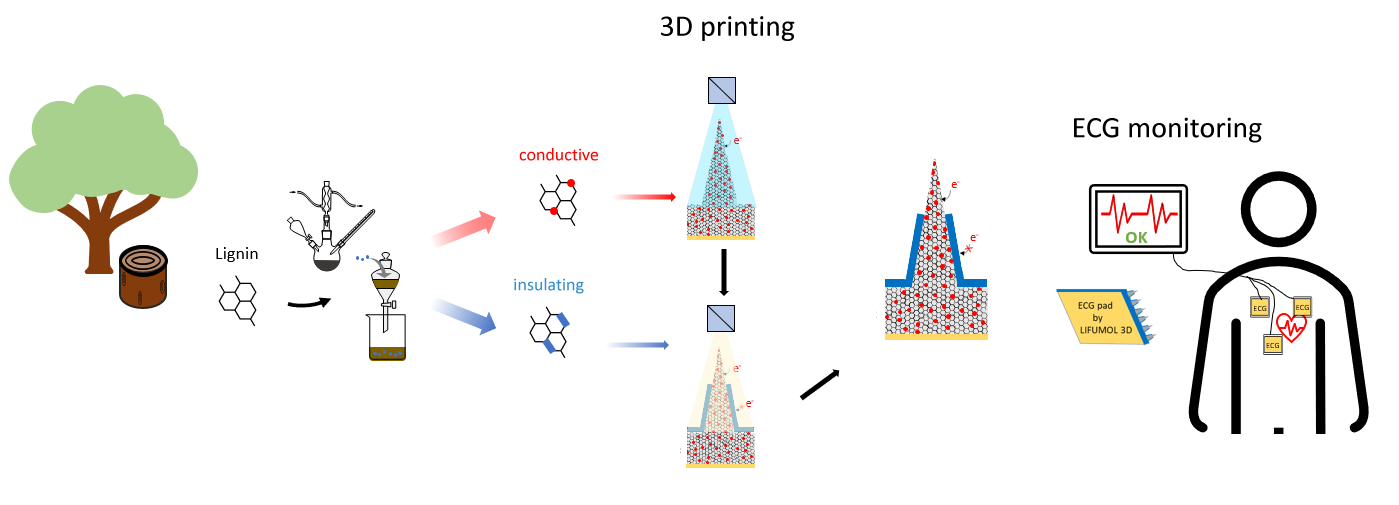
Additive manufacturing is expected to provide functional multi-materials with micron-scale resolution using environmentally sustainable processes. LIFOMUL 3D will implement the printing via projection-microstereolithography (PµSL) of materials based on lignin, the second-most abundant natural polymer and accumulating as byproduct of cellulose production. The goal is to achieve sub-100 µm feature sizes, biocompatibility and spatially controlled electrical conductivity. Electrocardiography- (ECG) and electroencephalography- (EEG) compatible microneedle electrodes for long term monitoring applications will be printed with superior signal quality and long-term stability. A high-resolution PµSL system will be developed for the hybrid printing of the conductive and insulating resins, eliminating the need for metal evaporation. LIFOMUL 3D will so establish a platform for the additive manufacturing of parts for medical applications with high resolution and obtained from renewable resources.
Additive manufacturing has been a game changer for structural complexity and functionality of polymer material systems in recent years. Despite the advantages for the environment utilizing generative rather than ablative material processing, it is vital that the future of additive manufacturing is based on renewable resources to further minimize its CO2 footprint. On this account, LIFOMUL 3D will implement a novel class of functional materials for 3D printing based on conductive/insulating lignin formulations.
The advantage of microneedles compared to established wet electrodes primarily lies in their drastically reduced skin-electrode impedance. By eliminating the need for skin preparation and/or the application of electrolytic gels, microneedle-based dry electrodes result in superior user comfort as well as signal quality and long-term stability. This is particularly relevant for specialty ECG and EEG applications such as long-term monitoring.
Regarding material development, the workflow will proceed from chemically modifying lignin for light-triggered photopolymerization and exploring functional additives to tailor electrical conductivity, over 3D printer development accounting for the variety of lignin sources (Kraft-lignin, Aquasolv-lignin, Organosolv-lignin) and intrinsic viscosities, molecular weights as well as impurities, ultimately leading to the design of lignin-based functional micro-multi-materials.
As well, a high-resolution PµSL system will be developed and used as manufacturing platform, allowing for fabricating microneedles with up to 700 µm height and a minimum feature size smaller than 10 µm at a high degree of automation. The system will be designed to permit hybrid printing of two different materials (conductive and insulating) and will incorporate a cleaning process of 3D-printed structures before switching from one material to the next one. This will enable the direct fabrication and usage of the printed microneedles for ECG- and EEG measurements without requiring further post-processing (such as metal evaporation), which require a high energy consumption and the use of metals with high environmental impact.
Pursuing these objectives, LIFOMUL 3D will path the way towards additive manufacturing via PµSL printing that is sustainable and addressing the demand for structural-functional polymer materials at the same time.
LIFOMUL 3D successfully demonstrated the additive manufacturing of high-resolution, multi-material microneedle electrodes based on a resin with renewable lignin compounts. Using a custom-developed projection microstereolithography (PµSL) platform, microneedle structures with heights of up to 600 µm and feature sizes below 10 µm were reproducibly fabricated from lignin-blended resin.
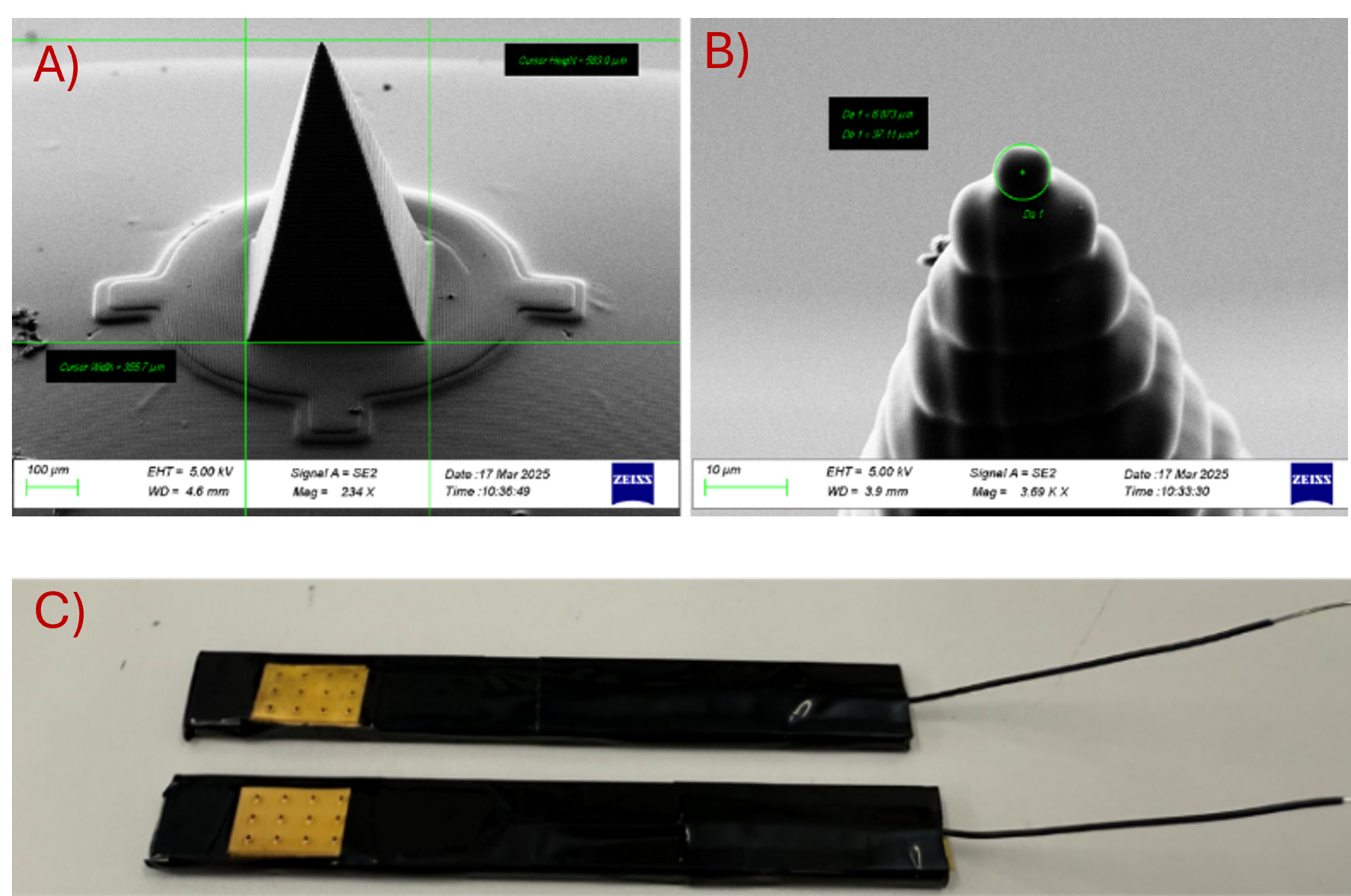
Images showing the overall geometry A) and tip detail B) of a lignin microneedle (~600 µm height, ~350 µm base, ~6.5 µm tip). C) Integrated lignin microneedle arrays: completed sensor prototypes with electrical connections for functional testing.
The printed microneedles exhibit sharp tip geometries, smooth sidewalls, and excellent structural fidelity across multiple length scales, as confirmed by scanning electron microscopy (SEM). The achieved resolution and shape accuracy meet the requirements of ECG and EEG electrodes, enabling reliable skin penetration. Functional prototypes were successfully integrated into electrode assemblies suitable for ECG and EEG monitoring, demonstrating electrical performance and mechanical robustness.
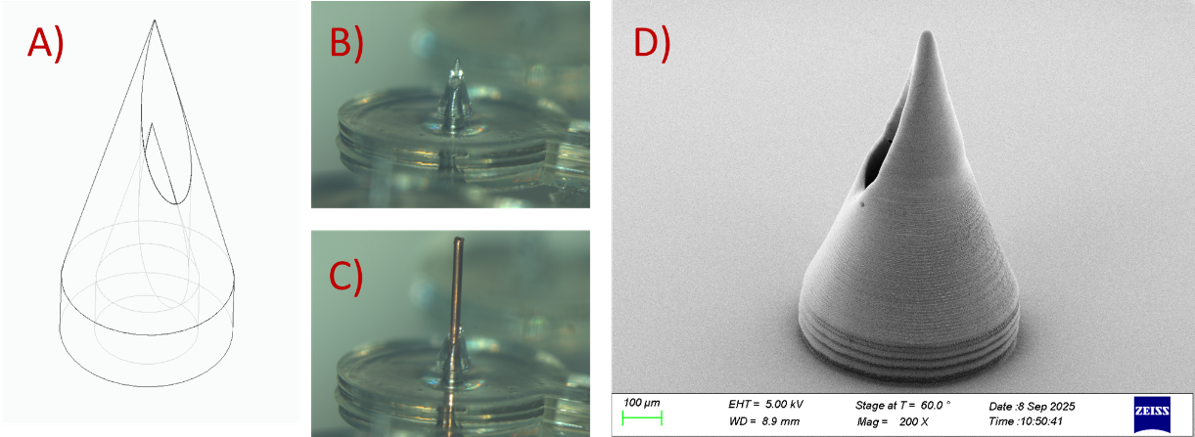
Hollow needles: A) 3D-Design; B-C) light microscope viewgraphs without/with wire; D) SEM-image
In addition to solid microneedle geometries, hollow microneedle structures were successfully fabricated using the developed PµSL process. The results demonstrate that complex internal channel architectures can be realized with high geometric fidelity, enabling the integration of functional features such as fluid transport or electrical wiring.
Optical microscopy images confirm the successful formation of continuous hollow channels, while SEM analysis reveals well-defined outer geometries and smooth surface quality of the printed needles. The capability to fabricate hollow microneedles further expands the application range of lignin-based microstructures, for example towards multifunctional bioelectrodes, sensing interfaces, or transdermal delivery systems.
These results underline the versatility of the developed lignin formulations and the PµSL platform, demonstrating that both solid and hollow microneedle designs can be manufactured within a single, sustainable additive manufacturing framework.
• M. Vigogne, C. Aeschbach, R. Bernhardt, A. Kaufmann*, J. Thiele*: “Step Test for Rapid Screening of Material and Process Parameters for Resin Development in DLP 3D Printing”, Angew. Chem. Int. Ed. 2025, e202504154. DOI: 10.1002/ange.202504154
• M. Vigogne, A. Kaufmann*, E. Grigoryev, C. Aeschbach, H. Lila, M. Schwidder, J. Thiele*: “Expanding the usage of lignin in DLP 3D printing by optimized synthesis and processing parameters”, ACS Applied Polymer Materials 2025, 7(22), 15255. DOI: 10.1021/acsapm.5c02394

LIFOMUL 3D was accepted for funding in the M-ERA.NET 2 joint call 2021, topic Materials for additive manufacturing.

M-ERA.NET 2 has received funding from the European Union’s Horizon 2020 research and innovation programme under grant agreement No 685451.

The Austrian Partners are funded in the frame of the FFG „Produktion der Zukunft – 39. AS PdZ Transnationale Projekte” program (project Nr. 40690189).
The partners from Saxony are funded by the SMWK.